
RevOps as a Service: Scaling Without Hiring
Revenue Operations
Feb 23, 2026
Outsource RevOps to get certified teams, faster implementations, and flexible costs — ideal for companies scaling revenue without hiring full-time staff.

RevOps as a Service (ROaaS) is a cost-efficient way for businesses to streamline sales, marketing, and customer success without the challenges of building an in-house team. Instead of hiring multiple specialists, companies partner with external providers to gain immediate access to expertise, scalability, and flexibility.
Key Takeaways:
Cost Savings: Outsourcing RevOps costs less than hiring full-time employees. For ~$10,000/month, businesses access a team of experts, avoiding six-figure salaries and recruitment expenses.
Scalability: Easily adjust resources for projects or slower periods without the long hiring process or fixed costs.
Expertise: Providers offer specialized teams skilled in CRM systems, data strategies, and integrations, delivering faster results (2–6 weeks vs. months for in-house teams).
Efficiency: With proven workflows, automation, and team-based support, outsourced RevOps ensures consistent performance, even if individual team members change.
This model is especially effective for companies generating $5M–$50M in annual revenue, where hiring delays and high costs can hinder growth. For businesses using platforms like HubSpot or Salesforce, ROaaS simplifies complex integrations and accelerates results.
1. In-House RevOps Team
Cost
Building an in-house Revenue Operations (RevOps) team comes with hefty upfront costs beyond just salaries. Here's a breakdown of typical salary ranges:
Analysts: $55,000–$75,000
Managers: $80,000–$120,000
Directors: $120,000–$180,000
VP/Head roles: $180,000–$300,000+
On top of these, you’ll need to account for benefits, taxes, training, and software licenses. To cover all necessary areas - strategy, analytics, integrations, and development - you’ll likely need multiple specialists, which further drives up expenses.
"RevOps pros work on the business, not just in it. That's what sets them apart from leaders like CROs." - Janae Tanner, Revenue Operations Professional
This structure can limit flexibility, especially when budgets are tight.
Scalability
Scaling an in-house team isn’t easy. Fixed costs like salaries and benefits don’t adjust with business performance, making it hard to scale up or down efficiently.
When growth accelerates, expanding the team takes time - recruiting, hiring, and onboarding qualified talent can take 6 to 12 months. During this ramp-up period, the team may struggle to keep up with higher operational demands.
On the flip side, if growth slows or market conditions change, those fixed costs remain. This can strain budgets during leaner times, unlike variable costs that adjust with business needs.
Expertise
RevOps requires a mix of technical and strategic skills, including CRM administration, SQL, BI tools, API integrations, and process design. It’s also critical to manage cross-departmental changes effectively.
"Expecting one person to be a strategist, technologist, analyst, and operator is unrealistic." - RevPartners
Because of this, businesses often need multiple specialists to cover all these areas, which adds complexity and cost.
Efficiency
A fully staffed in-house team can use automation to cut routine tasks by 40%. Leveraging AI can also speed up sales cycles, increase profitability, and improve win rates. However, reaching this level of efficiency takes time. You’ll need to establish strong data governance and cleanup, clear service-level agreements (SLAs), and conduct regular audits.
Another potential risk? Losing key team members. If someone with critical knowledge leaves, it can disrupt operations and slow progress.
These challenges highlight why many companies turn to outsourced RevOps solutions, which offer faster and more flexible scaling without the hiring headaches.
24 | Driving Growth with RevOps-as-a-Service | Cliff Simon
2. RevOps as a Service (e.g., Multithread)
RevOps as a Service offers an alternative to traditional hiring by reshaping costs, scalability, and access to specialized expertise.
Cost
For less than the price of a single hire (typically $120,000+ including taxes and benefits), you gain access to an entire team of specialists.
"Almost always we're going to be cheaper than internal hiring. For $10K a month, you usually get two or three people working on your account, not just one." - Tate Stone, CEO, RevBlack
Pricing starts at $7,750/month for 40 hours of tactical support and goes up to $21,950/month for 120+ hours with a dedicated team handling complex tasks. Beyond salary savings, you avoid recruitment expenses ($5,000–$20,000 per hire), ongoing training costs ($5,000–$15,000 annually), and the overhead tied to full-time employees.
Scalability
The model’s flexibility allows you to adjust hours based on your needs. For example, you can add 60+ hours for a CRM migration or scale back during slower periods - without worrying about layoffs or severance.
This adaptability is especially valuable for companies experiencing uneven growth. Early-stage businesses might start with 10–15 hours per month and gradually increase to 40–80+ hours as revenue grows from $5M to $20M+. This ensures your operational capacity aligns with revenue performance, rather than being locked into fixed staffing levels.
Expertise
Service providers bring a team of specialists - like CRM architects, data strategists, and systems analysts - reducing reliance on any single individual. These teams often hold 140+ certifications across platforms such as Salesforce, HubSpot, and Clay.
"We engineer systems for scale rather than tailoring to individual approaches." - Tate Stone, CEO, RevBlack
Their experience spans multiple industries, enabling them to identify patterns and solve recurring challenges. For instance, in October 2025, GRIN partnered with RevBlack to resolve issues with a HubSpot and Salesforce migration. The team stabilized integrations, rebuilt automations, and reduced lead routing time from hours to seconds - doubling overall system performance. Similarly, in February 2026, Property Vista worked with RevBlack to unify siloed systems, transforming their marketing operations in under two months and achieving a 230% increase in email engagement.
Efficiency
Projects with service providers are completed in 2–6 weeks, compared to the 3–6 months it typically takes for in-house teams. Providers rely on proven playbooks and automation to handle repetitive tasks like lead routing and data entry, freeing your staff to focus on revenue-driving activities.
This approach also ensures continuity. When a key in-house employee leaves, operations can stall. With a service provider, you have an entire team supporting your account, eliminating single points of failure. Companies with established RevOps functions are 1.4 times more likely to exceed revenue goals by 10% or more, and nearly 75% of the highest-growth companies are expected to adopt this model by 2026.
These factors make RevOps as a Service a strong contender when compared to traditional in-house solutions.
Pros and Cons
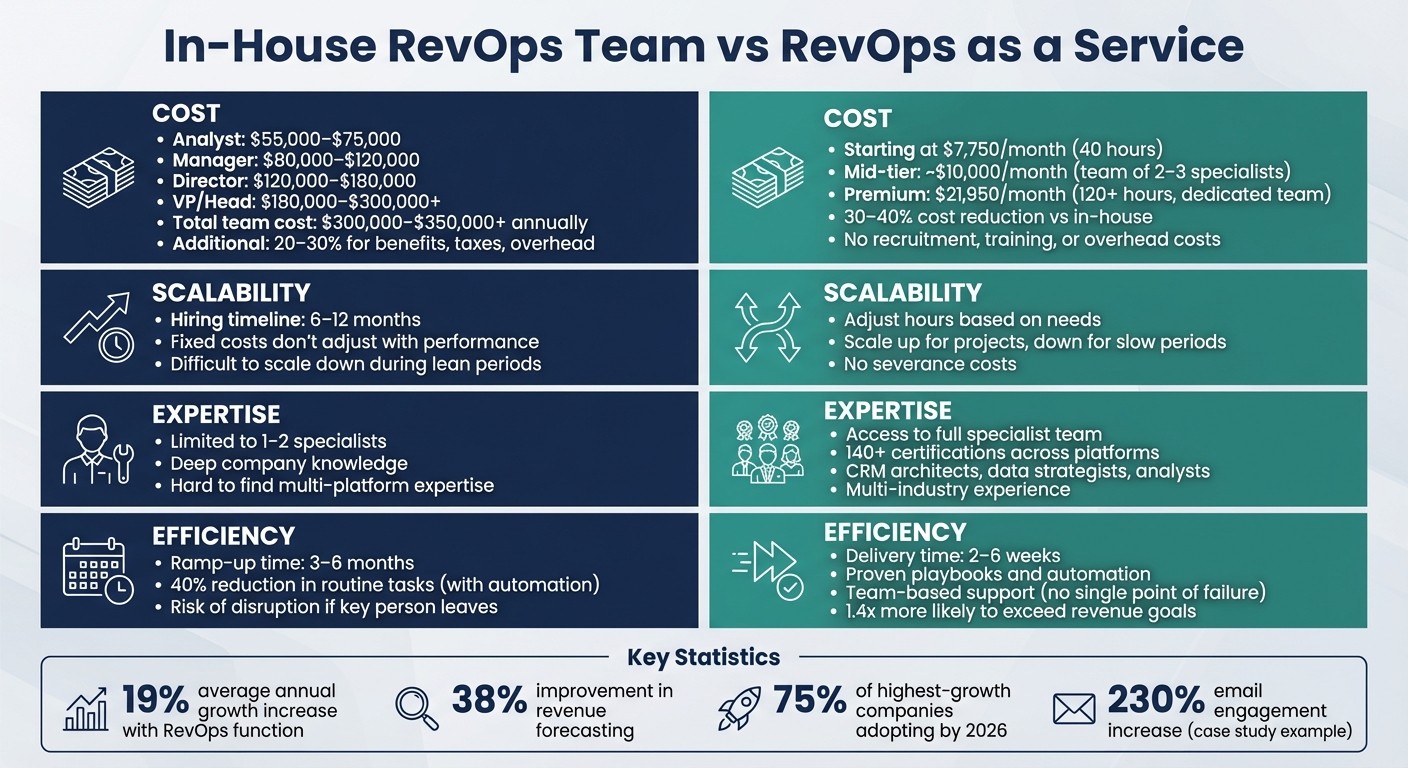
In-House RevOps vs RevOps as a Service: Cost and Performance Comparison
When weighing the choice between an in-house RevOps team and RevOps as a Service, it’s all about balancing costs, expertise, flexibility, and efficiency. The table below breaks down the key differences between the two options:
Factor | In-House RevOps Team | RevOps as a Service (Outsourced) |
|---|---|---|
Cost | Fixed salaries ranging from $110,000–$120,000+ per role, plus 20–30% for benefits, payroll taxes, and overhead. A complete team can cost over $300,000–$350,000 annually. | Monthly retainers that vary based on services. For around $10,000 a month, you can access multiple specialists - less than the cost of hiring one full-time employee. |
Scalability | Slow and rigid. Hiring new talent can take 3–6 months, and scaling down during lean times is difficult. | Highly flexible. You can add resources for big projects or reduce them during slower periods without severance costs. |
Expertise | Strong knowledge of your company but limited to the skills of one or two hires. Finding someone proficient in Salesforce, HubSpot, and data strategy is rare and expensive. | Access to a team of specialists with diverse expertise, including CRM architects, data strategists, and analysts. |
Efficiency | Can take 3–6 months to ramp up and deliver results. Productivity may be interrupted by vacations, sick leave, or staff turnover. | Typically delivers results within 2–6 weeks using established playbooks. Team-based support avoids gaps caused by individual absences. |
This side-by-side comparison highlights the trade-offs between the two models. In-house teams bring a deeper connection to your company’s culture and build long-term knowledge, but they come with high fixed costs that don’t fluctuate with performance. As Tate from RevBlack puts it:
"You can't tell an employee, 'we had a bad month, I'll pay you 75k instead of 120k.' That never works."
On the other hand, outsourcing offers the flexibility to scale resources up or down as needed, predictable costs, and quicker results. While it may lack the cultural alignment of an in-house team, it provides access to a broader range of expertise without the commitment of full-time hires. Deciding between these options depends on your business’s growth goals and operational needs.
Conclusion
Deciding between building an in-house RevOps team and opting for RevOps as a Service boils down to three key factors: speed, cost, and expertise. The on-demand nature and quick implementation of RevOps as a Service make it a strong choice for growing companies - especially those using HubSpot. This model gives businesses instant access to a team of specialists, including CRM architects, data strategists, and analysts.
Outsourcing can reduce recruitment, salary, and overhead expenses by 30–40%. Additionally, companies with a dedicated RevOps function see an average 19% increase in annual growth and a 38% improvement in revenue forecasting. For HubSpot users, this approach eliminates the challenge of finding a single hire skilled in CRM architecture, automation workflows, and go-to-market strategy.
For Series A or B startups scaling from $5M to $20M, starting with a pilot project is a smart move. Testing a RevOps provider on focused initiatives - like lead routing automation or a CRM audit - allows you to measure results, such as pipeline per rep and sales cycle speed, before committing to a long-term partnership.
HubSpot users, in particular, can benefit from working with certified experts who specialize in complex integrations and advanced Operations Hub workflows. This collaboration can lead to measurable gains in MQLs, faster sales cycles, and overall revenue growth.
A hybrid approach is also gaining traction: keeping core revenue operations in-house while outsourcing high-impact, specialized projects to external experts. This strategy provides enterprise-level capabilities without the financial burden of a full-time team.
FAQs
How do I know if RevOps as a Service is right for my company?
RevOps as a Service could be a smart choice if your business is expanding quickly but finding it difficult to build or retain an internal RevOps team. Challenges like high costs, limited talent availability, or tight timelines can make this approach appealing. It offers access to expert support and tools that can adjust to your needs - without the expense of hiring full-time staff. Whether you require fast implementation across departments like sales and marketing or need flexible help to manage changing priorities, this model might align well with your goals.
What should I ask before signing a RevOps as a Service contract?
Before committing, consider asking about how the costs compare to hiring an in-house team and the range of services provided, such as data management or systems integration. Look into whether they offer tailored solutions that align with your business needs. It's also crucial to establish clear performance metrics upfront and get details about the onboarding process and ongoing support. Be cautious of warning signs like unclear deliverables or working with providers that lack proper regulation - these could put your business at risk.
How do I measure ROI from RevOps as a Service?
To gauge the return on investment (ROI) from RevOps as a Service, focus on key metrics such as sales cycle length, customer lifetime value (CLV), and revenue growth. It's essential to weigh the costs of the service and its implementation against measurable gains in these areas.
A well-structured RevOps model can have a noticeable impact on business performance. For instance, it can lead to a 10–20% increase in revenue, improve sales productivity by 15–30%, and deliver an impressive 100–200% ROI on marketing spend. These numbers underscore the measurable value RevOps can bring to your organization.