AI-Driven Champion Tracking: Boost Win Rates, Shorten Sales Cycles & Prevent Churn
Revenue Operations
Feb 12, 2026
Feb 13, 2026
Automate tracking of customer champions' job changes to speed outreach, increase win rates, grow pipeline, and reduce churn with AI-driven CRM alerts.

AI-driven champion tracking helps sales teams identify and engage with key advocates (champions) when they change jobs. These champions already trust your product, making them 5x more likely to convert compared to cold prospects. Tools like Multithread automate this process by scanning 30+ data sources daily, updating your CRM, and sending real-time alerts. This allows teams to act quickly, often reaching champions within 24 hours of their job change.
Key Benefits:
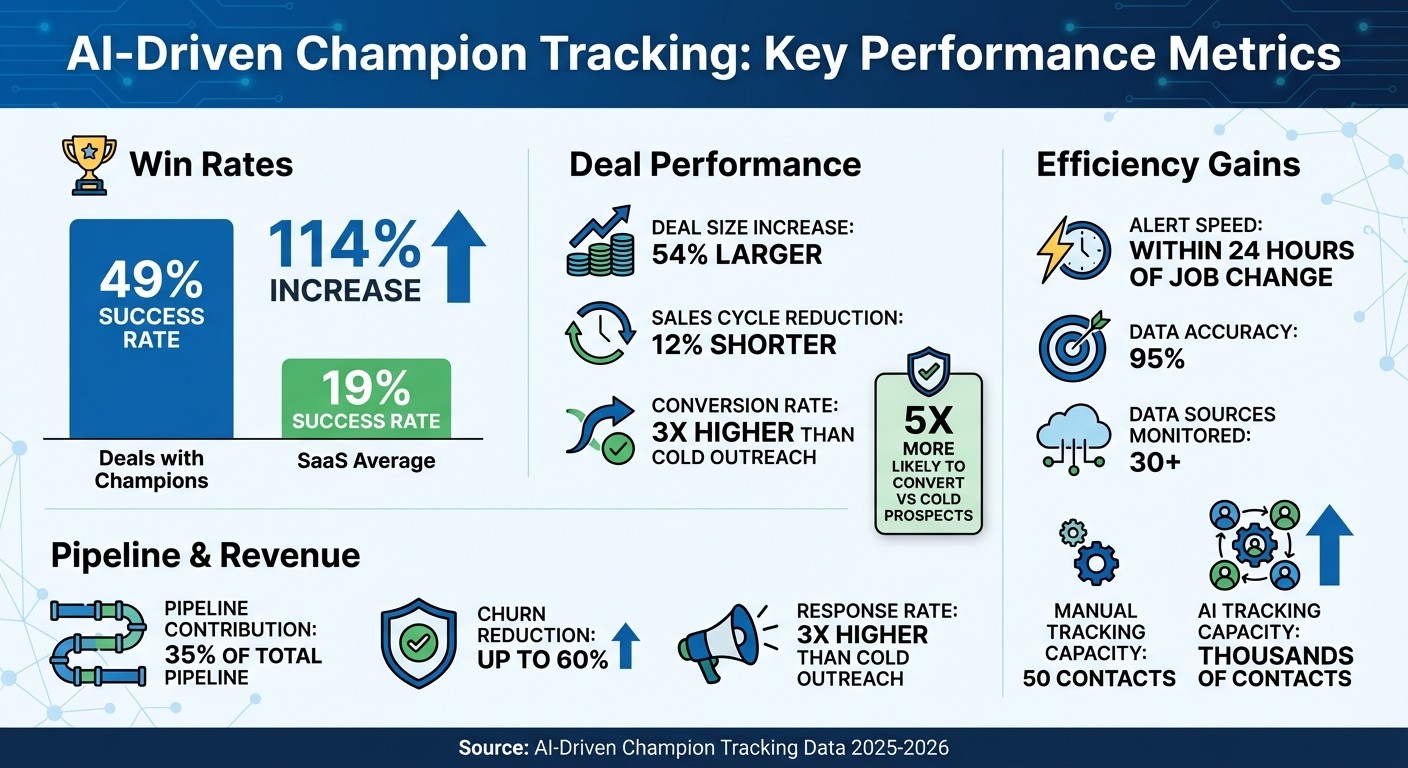
Higher Win Rates: Deals with champions have a 49% success rate, compared to the 19% SaaS average.
Faster Sales Cycles: Shorten time-to-close by 12%.
Churn Prevention: Reduce churn risk by up to 40% with early alerts when champions leave active accounts.
Pipeline Growth: Champion tracking can contribute to 35% of your total pipeline.
By automating champion tracking, businesses like Workplaze and Blinkist have seen measurable results, including millions in ARR and increased reply rates. This strategy transforms how sales teams approach revenue growth and retention.
AI-Driven Champion Tracking Impact on Sales Metrics
Revolutionizing Sales Strategies with Rachit Kataria
What is AI-Driven Champion Tracking?
AI-driven champion tracking refers to the automated process of monitoring key stakeholders as they change roles or receive promotions. Using AI, data sources are scanned to detect job changes, and your CRM is updated instantly.
This method tackles a major scalability issue. While a sales rep might manually track around 50 top contacts, AI can monitor thousands of CRM entries at once. It goes beyond job titles, analyzing LinkedIn profiles and CRM histories to identify personas like HR leaders or strategic decision-makers. When a champion moves to a new company, the AI evaluates whether the organization aligns with your Ideal Customer Profile (ICP), often assigning a fit score to prioritize follow-ups.
Who Are Champions in B2B Sales?
Champions in B2B sales are the individuals who actively drive product adoption, approve renewals, and advocate for your solution within their networks. These are the users who engage deeply with your product, provide positive feedback, or have decision-making authority in past deals. It's crucial to focus on champions with cross-functional influence, as they are the ones worth tracking.
How AI Powers Champion Tracking
AI streamlines three key tasks that are otherwise hard to manage at scale. First, it tracks job-change signals on platforms like LinkedIn. Second, it updates your CRM with fresh contact details - such as new email addresses and LinkedIn profiles - usually within 24 hours. Third, it evaluates past deal data to determine how influential a contact was in previous successes. These AI-driven insights are pivotal for improving CRM efficiency and driving revenue growth.
Take Blinkist in 2025 as an example. They used tools like Clay and HubSpot to identify contacts who had moved to companies with over 100 employees, referencing past deal data for tailored outreach. Slack approvals ensured the process stayed authentic, blending automation with human oversight. This "human-in-the-loop" system reduced manual work while preserving a personal touch.
By automating these processes, businesses can achieve measurable outcomes, which leads us to why champion tracking is so impactful.
Why Champion Tracking Matters
Champion tracking has a direct influence on critical revenue metrics like pipeline growth, win rates, and churn prevention. When a champion moves to a new company, their trust in your solution creates warm leads that convert three times more effectively than cold outreach. Additionally, having a champion on a buying committee can boost win rates by 114% and result in deals that are 54% larger.
On the flip side, if a champion leaves an active account, it can signal potential churn. This early warning allows your team to pivot quickly, identifying and nurturing new advocates within the account. With modern B2B purchases involving 6 to 12 stakeholders, champion tracking becomes a crucial strategy to maintain strong relationships across an organization.
Metric | Impact of Champion Tracking |
|---|---|
Win Rate | 114% increase |
Deal Size | 54% larger |
Sales Cycle | 12% shorter |
Response Rate | 3x higher than cold outreach |
Pipeline Contribution | ~35% of total pipeline |
How to Implement AI-Driven Champion Tracking
You don’t need to overhaul your sales process to make AI-driven champion tracking work. With the right configuration in HubSpot, you can automate everything - from identifying key contacts to triggering tailored outreach - in just about 30 minutes. The process boils down to three main steps: identifying the champions, automating how you monitor them, and creating personalized engagement strategies. These steps fit neatly into your existing HubSpot setup, making the transition smooth and efficient.
Step 1: Identify Champions with AI
Start by defining who qualifies as a "champion" in your HubSpot CRM. These aren’t just any contacts - they’re the decision-makers, power users, or NPS promoters who played a key role in past deals. They’re the people with real influence, and identifying them is essential for unlocking their potential to drive revenue growth. Multithread combines human insight with AI to scan your CRM and pinpoint the entire buying committee by analyzing factors like product usage, deal history, and engagement patterns.
To narrow your focus, apply specific filters. For instance, you might track former customers from companies with over 100 employees or champions involved in deals worth more than $50,000. Multithread’s AI enrichment takes it a step further by adding firmographics and web intelligence to your account records. This means that when a champion moves to a new company, you’ll immediately know if their new employer matches your Ideal Customer Profile.
This targeted approach has proven effective. Companies that focus on high-value champions and pre-qualify their new organizations see much higher reply rates compared to standard cold outreach campaigns.
Step 2: Automate Real-Time Champion Tracking
Once you’ve identified your champions, the next step is setting up automation in HubSpot to track their career moves. Multithread scans over 30 data sources daily, ensuring you’re alerted to job changes within 24 hours with an impressive 95% data accuracy rate.
When a champion changes roles, your CRM gets updated instantly with the new details. Real-time Slack alerts can be triggered, prompting immediate follow-up. You can even automate task creation for your Account Executives or SDRs to make sure every opportunity is acted upon.
For example, in 2025, Blinkist implemented a workflow that filtered new companies based on factors like employee count and historical deal data. They used multiple AI models to identify accurate contact information, making their process both precise and efficient.
With real-time tracking in place, you’re ready to move on to crafting outreach strategies that are as personalized as they are effective.
Step 3: Build Personalized Engagement Strategies
Once you’ve automated detection, the focus shifts to creating outreach that feels personal, not robotic. Use AI to pull in internal CRM data - like product usage, deal history, and tenure - to craft messages that genuinely resonate. Combine this with external research about the champion’s new role or company to reference specific projects or past successes in your communications.
Consider adding a human element by routing AI-generated drafts to Slack for review before sending them out via HubSpot sequences. This approach has proven to save time; for instance, Platterhub AI reported saving 20 hours per week through automated research.
Finally, coordinate your outreach across multiple channels. Use HubSpot for email sequences while integrating with LinkedIn tools to engage champions where they’re most active. To avoid redundancy, set up automation to remove contacts from other sequences once they respond on any platform. In 2025, Lattice used this multi-channel approach, blending AI-generated business cases with personalized messaging, and saw a 25% year-over-year boost in late-stage win rates.
Key Metrics for Champion Tracking Success
When it comes to automated champion identification, tracking the right metrics is essential to refine your sales strategy. By focusing on measurable outcomes, you can directly assess how champion tracking impacts revenue. Without this data, it’s tough to determine whether your efforts are driving results or simply creating extra tasks for your team.
These key metrics fall into three main categories: win rates and deal influence, churn prevention and retention, and pipeline accuracy with revenue growth. Each provides a unique lens to evaluate how champions contribute to closing deals, retaining customers, and improving forecasts.
Track Win Rates and Deal Influence
Start by measuring win rates for deals influenced by champions. Research shows these deals can increase your win probability by 114%. If you're using HubSpot, consider adding the "Deal Score" property to your dashboards. This AI-driven score (ranging from 0 to 100) evaluates deal properties, sales activity, and buyer signals like email engagement. It refreshes every six hours when "Fast Triggers" occur - such as overdue tasks or scheduled meetings - giving you real-time deal insights.
Beyond win rates, compare the Average Contract Value (ACV) of champion-led deals to standard prospects. Deals involving champions often result in contracts that are 54% larger. Keep an eye on the number of contacts tied to each deal - more engaged stakeholders not only improve deal influence but also lower churn risks.
AI tools can also flag stalled deals, helping you re-engage champions at the right time to keep opportunities moving forward.
Monitor Churn Prevention and Retention
Champions don’t just close deals - they help ensure long-term customer retention. When a champion leaves an account, it’s a major churn risk. Tracking these departures quickly allows for immediate multi-threaded outreach to stabilize the account.
Set up a CRM dashboard to monitor "Champion Coverage", which tracks how many active champions you have per account. For enterprise-level deals, aim for three to five advocates to maintain account stability. Companies with mature champion tracking systems often see net revenue retention improve by 35% and customer churn decrease by 45%.
Automated alerts can trigger "De-risking Plays" when champions leave, prompting outreach to other stakeholders within the account. Additionally, track new executives joining accounts so your Customer Success team can build relationships before any major changes occur.
Another key metric is the Reactivation Rate - how often "Closed-Lost" or churned accounts reopen when a former champion joins a new company. For example, in 2025, cybersecurity firm Cobalt tracked a champion who moved to a new role. While typical deals took five to six months and averaged $40,000, this champion-led deal closed in just three weeks for $90,000. This highlights how tracking former champions can significantly boost deal size and velocity.
Retention tracking also plays a critical role in improving revenue forecasts, as outlined below.
Analyze Pipeline Accuracy and Revenue Growth
AI-driven champion tracking can significantly enhance revenue forecasting. Start by evaluating the total pipeline value generated from champion tracking workflows. Compare the win rates of these leads to those from cold outreach - champion-led leads tend to convert at three times the rate of cold prospects. On average, companies leveraging automated champion tracking report that 35% of their pipeline stems from job-change signals.
Measure the speed of your response after detecting a job change. Top teams aim to reach out within 24 hours. Also, track how many job changes align with your Ideal Customer Profile (ICP) and the resulting meeting conversion rates. AI tools can help by researching the new company and scoring its ICP fit based on factors like size and industry before routing the lead to sales.
Re-engaging a former champion in their new role can reduce the sales cycle by 12%. Use historical CRM data to forecast high-intent relationships and prioritize those leads.
Metric Category | Key Performance Indicator | Impact on Sales Outcome |
|---|---|---|
Win Rates | Champion Influence Rate | 114% increase in win probability |
Deal Size | Average Contract Value (ACV) | 54% larger deals when champions are involved |
Efficiency | Sales Cycle Length | 12% reduction in time-to-close |
Pipeline | Conversion Rate | 3x higher conversion compared to cold outreach |
Retention | Multi-thread Depth | Helps prevent churn when a single champion departs |
Refine Your Strategy with Multithread Insights
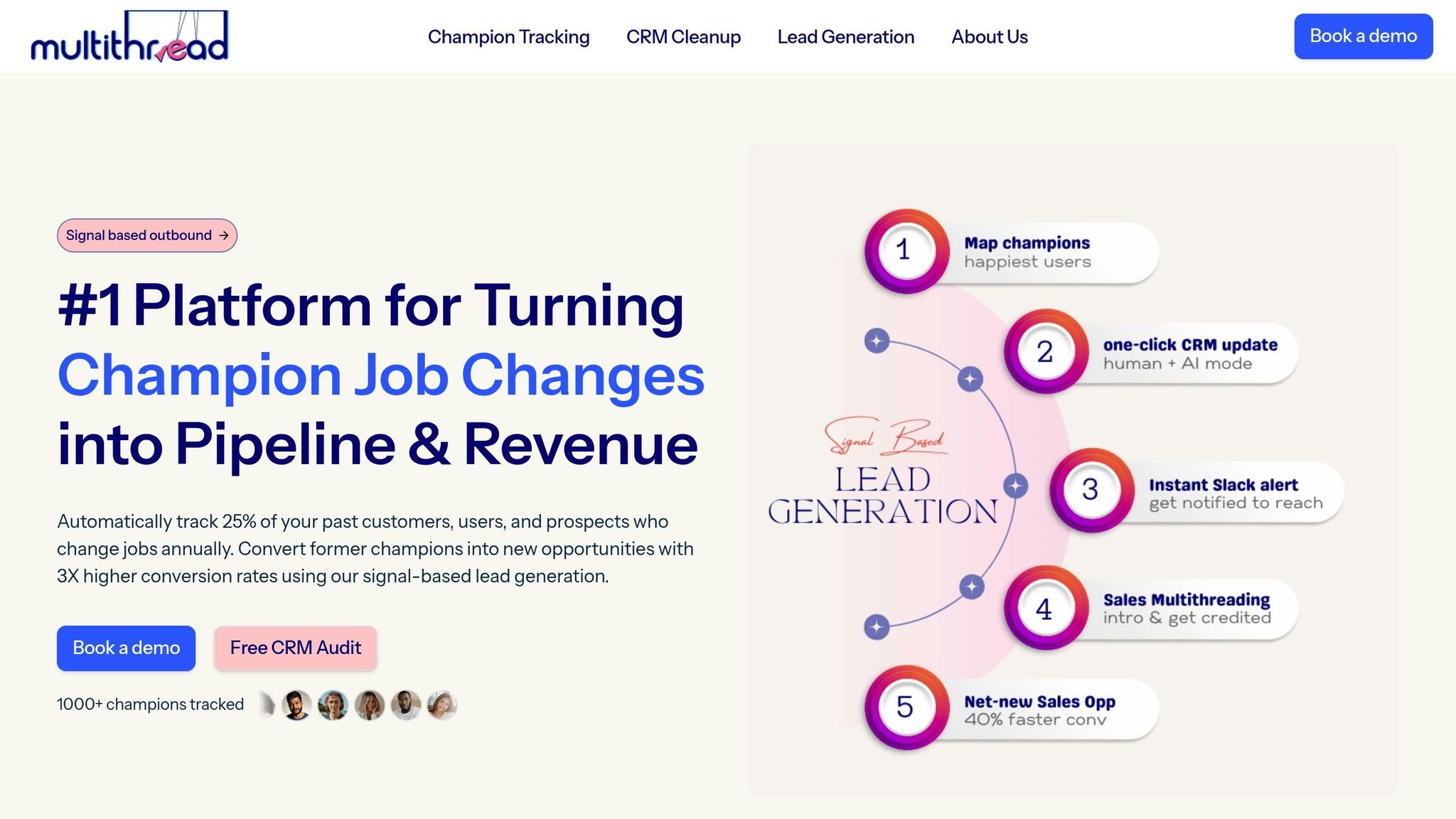
After identifying and tracking champions, the next step is to refine your strategy using detailed insights. While tracking champions lays the groundwork, analyzing their data is what drives smarter adjustments. Multithread's RevOps Reporting and Analytics dashboard simplifies this process by offering clear metrics on how champion job changes affect revenue. It measures attribution, conversion rates, and pipeline velocity - taking the guesswork out of your strategy. By reviewing key data trends, you can fine-tune your approach to champions and unlock more qualified opportunities.
Use Data Trends to Improve Performance
Where do your champions go? If you notice that former advocates frequently transition to companies within specific industries or of a certain size, it might be time to tweak your Ideal Customer Profile (ICP) to target those segments more effectively. Multithread's analytics reveal that former champions convert into new opportunities at three times the rate of cold prospects.
Timing also matters. Top-performing teams reach out to champions within 24–48 hours of their job change. If your team struggles with speed, Multithread's Slack integration can send instant alerts, enabling reps to act immediately.
Another important trend involves churn risk identification. Multithread's Account Health Monitoring dashboard flags stakeholder departures across your customer accounts, serving as an early warning system to protect at-risk relationships. When a champion leaves, you can immediately implement retention strategies to engage other stakeholders before the account cools. Companies using this method have reported reducing churn by up to 60%.
Once you’ve identified these trends, the next step is to integrate them into your revenue operations workflow for maximum impact.
Integrate Insights into Revenue Operations
To get the most out of your insights, connect Multithread with your HubSpot CRM and outreach tools. This allows you to automatically update contact records and trigger workflows, including a human-in-the-loop approval step for high-value champions. This ensures that AI-generated outreach remains personalized and effective.
Leverage Multithread's Lead Scoring Dashboard to prioritize former champions based on their likelihood to convert. The system uses historical CRM data - such as past deal sizes, products used, and the depth of previous relationships - to craft outreach messages that feel tailored and relevant. Vivek Srivastava, Co-founder & COO of Platterhub AI, shared how this functionality significantly improved his team’s efficiency:
"We cut our data enrichment costs by 15x while improving accuracy. The automated research alone saved our team 20 hours per week." - Vivek Srivastava, Co-founder & COO, Platterhub AI
Finally, work with your Marketing team to set up personalized automation campaigns for champions who change jobs. Tag key contacts - such as "Power Users", "NPS Promoters", and "Closed-Won Decision Makers" - in your CRM so Multithread can track them automatically. Use filters to alert your reps only when a champion’s new company aligns with your ICP criteria, like industry or employee count. This keeps your team focused on high-value opportunities and avoids wasting resources on unqualified leads.
Conclusion
AI-driven champion tracking goes beyond simply monitoring contacts - it's about safeguarding revenue and driving growth by nurturing relationships with those who already trust your product. The sheer volume of job changes in your network makes manual tracking impractical. That’s where Multithread steps in, automating the process and sending real-time alerts so your team can respond within 24–48 hours of a job change.
The numbers speak for themselves: former champions are three times more likely to convert than cold prospects, and deals close up to seven times faster due to the trust already established. Take Harish Mohan, CEO and Founder of Workplaze, as an example. Over six months leading up to February 2026, he generated $1M ARR in pipeline using Multithread's champion tracking, achieving an impressive 23% reply rate from job change campaigns. Beyond improving conversions, this system helps mitigate account risks. When key stakeholders leave, Multithread sends immediate alerts, empowering your team to engage with new decision-makers. Companies using this strategy have reported up to a 60% reduction in churn.
This seamless approach aligns perfectly with earlier strategies for optimizing revenue operations, ensuring that every interaction with a champion delivers tangible results. By integrating Multithread with tools like HubSpot CRM, you can automate workflows, eliminate manual data entry, and keep your team focused on opportunities that matter most.
Whether your goal is to increase win rates, speed up sales cycles, or reduce churn, Multithread’s AI-powered champion tracking delivers the timing and insights you need to turn warm leads into closed deals.
FAQs
How do I define a “champion” in my CRM?
A "champion" in your CRM refers to a crucial contact within a target account who actively supports your product and plays a role in influencing decisions. These individuals are often current or past users who have had positive experiences with your solution, making them natural promoters. Keeping tabs on champions means tracking their career moves or changes in roles, as these shifts can highlight potential opportunities for expansion or warn of possible risks like churn.
What’s the best follow-up timeline after a champion changes jobs?
The best time to follow up is within 90 days. Reconnecting with champions during this period can help boost your pipeline and revenue by tapping into their new roles and networks. Acting quickly keeps you relevant and strengthens those important relationships.
How do I measure champion coverage to reduce churn?
Tracking the career movements of your key advocates - like job changes, promotions, or role shifts - can provide powerful insights into champion coverage and churn reduction. These transitions often open doors for re-engagement or upselling opportunities.
Key metrics to watch include the percentage of champions changing roles within a specific period and their likelihood to repurchase. Keeping tabs on these changes in real time allows you to maintain strong connections, reach out at the right moments, and lower the risk of churn.